Obiettivi del Corso
This machine learning course provides a solid introduction to the principles of modern AI, combining theory and hands-on practice.
It begins with linear algebra, covering vectors and matrices as essential tools for data representation. Students then explore optimization through gradient descent and mini-batch techniques to efficiently train models.
The course introduces artificial neurons, explaining weighted inputs and activation functions, and how they simulate biological processes. These neurons are combined into neural networks capable of learning complex patterns via backpropagation.
Emphasis is placed on real-world applications such as image recognition and classification. Practical exercises are integrated throughout the course.
Students will use popular Python libraries—PyTorch, TensorFlow, and Keras—to build, train, and evaluate machine learning models. By the end, learners will understand both the theory and implementation of core machine learning systems.
General Objectives
- To provide a solid foundational understanding of the core principles of machine learning and artificial intelligence.
- To develop students’ ability to connect mathematical concepts with practical machine learning techniques.
- To equip learners with the skills necessary to build, train, and evaluate machine learning models.
- To foster critical thinking about the design and application of intelligent systems in real-world contexts.
- To introduce the use of industry-standard tools and frameworks for machine learning development.
Specific Objectives
- Understand and apply key mathematical concepts such as vectors, matrices, and linear algebra in the context of machine learning.
- Explain the mechanics of gradient descent and its variations (e.g. mini-batch) for optimizing model performance.
- Describe the structure and function of artificial neurons and activation functions.
- Construct and train basic neural networks, understanding how weight adjustments and backpropagation work.
- Use Python libraries such as PyTorch, TensorFlow, and Keras to implement machine learning workflows.
- Build models capable of performing tasks like classification, prediction, and pattern recognition.
- Analyze model performance and identify strategies for improving accuracy and generalization.
- Gain hands-on experience developing and deploying machine learning models in real-world scenarios.
RICHIEDI INFORMAZIONI
Programma
The Online Course: Machine Learning – From Zero To Hero – English Language ha una durata complessiva di 36 ore così suddivise:
- Videolezioni o lezioni testuali: 7 ore
- Sviluppo dello studio personale: 29 ore
La struttura del corso è chiara e orientata alla pratica: dopo una fase iniziale di installazione e configurazione, sarai guidato attraverso una serie di esercitazioni concrete che ti permetteranno di sviluppare passo dopo passo il software di cui hai realmente bisogno.
L’approccio è pensato per accompagnarti dall’idea alla realizzazione, con un taglio semplice ma efficace, adatto sia a chi non ha mai programmato sia a chi vuole migliorare la propria produttività grazie all’intelligenza artificiale.
Ogni modulo offre spiegazioni chiare, esempi immediatamente applicabili e risorse utili per consolidare quanto appreso. Inoltre, il corso sarà soggetto a continui ampliamenti e aggiornamenti per restare sempre al passo con l’evoluzione rapidissima di questa tecnologia, così da garantirti contenuti sempre attuali e rilevanti.
Al termine, avrai acquisito la capacità di sviluppare applicazioni complete sfruttando la potenza dell’IA di Claude Code, riducendo tempi e costi, e aprendo la strada a nuove opportunità professionali e imprenditoriali.
PROGRAMMA DETTAGLIATO
MODULO I: What Is Machine Learning. Introductory section on the fundamental concepts of machine learning
- Lezione 1 – What is machine learning. In this lesson you will learn the definition of “Machine Learning
- Lezione 2 – How machine learning works. In this lesson you will learn how machine learning works, compared to traditional programming
- Lezione 3 – The areas of machine learning. In this lesson you will learn which are the three major areas of machine learning
- Lezione 4 – Supervised learning. In this lesson you will learn the foundation of supervised learning
- Lezione 5 – Linear Regression in Traditional Programming. In this lesson you will learn about linear regression in traditional programming
- Lezione 6 – Linear regression in machine learning. In this lesson you will learn linear regression in machine learning
- Lezione 7 – Full batch, mini batch, stochastic gradient descent. In this lesson you will learn some variations of the gradient descent algorithm in machine learning
- Lezione 8 – The artificial neuron. In this lesson you will learn about the artificial neuron and about neural networks in machine learning
- Lezione 9 – Linear regression with a single neuron. In this lesson you will learn how linear regression with a single neuron works
MODULO II: Regression – Section dedicated to linear regression techniques
- Lezione 1 – Linear Regression with Algebraic Method part 1
- Lezione 2 – Linear Regression with Algebraic Method part 2
- Lezione 3 – Linear Regression in One Dimension. In this lesson you will learn how to perform a linear regression in one dimension with the algebraic method and plot the results
- Lezione 4 – Linear Regression in Machine Learning. In this lesson you will learn how to perform a linear regression in machine learning
- Lezione 5 – A True Simple Neural Network. In this lesson we introduce a very simple neural network to perform multivariate linear regression
- Lezione 6 – Linear regression with two dependent variables (part 1)
- Lezione 7 – Linear regression with two dependent variables (part 2)
MODULO III: Classification. Section dedicated to classification problems with deep neural networks.
- Lezione 1 – Deep Neural Network. In this lesson we introduce a deep neural network that solves a classification problem
- Lezione 2 – Definition of the Class. In this lesson you will learn how to define a classification network
- Lezione 3 – Training the Model. In this lesson you will learn how to train the digits recognition model
- Lezione 4 – Testing the Model. In this lesson, we will perform a point-by-point recognition of some images for a detailed evaluation of the created model’s performance
MODULO IV: Unsupervised learning – clustering and dimensionality reduction
- Lezione 1 – Presentation of K-Means Clustering. In this lesson you will learn the K-Means clustering algorithm
- Lezione 2 – Coding K-Means Clustering. In this lesson you will learn to perform K-Means algorithm in Python
- Lezione 3 – Presentation of DBSCAN Clustering – In this lesson you will learn the DBSCAN clustering algorithm
- Lezione 4 – Coding DBSCAN Clustering. In this lesson you will lean to code a DBSCAN clustering program in python using the sklearn library
- Lezione 5 – Dimensionality Reduction. In this lesson you will learn the basic principles of dimensionality reduction
- Lezione 6 – Dimensionality Reduction in practice. In this lesson you will learn how to write a script to perform dimensionality reduction in Python
MODULO V: Reinforcement Learning. Section dedicated to reinforcement learning
- Lezione 1 – Introduction to Reinforcement Learning. In this lesson you will learn the foundations of reinforcement learning
- Lezione 2 – The Cartpole Environment. The purpose of this lesson is to demonstrate how to train a reinforcement learning agent using the PPO algorithm on a classic problem — the CartPole environment
- Lezione 3 – The Lunar Lander Environment. This lesson demonstrates how to train a reinforcement learning agent using Proximal Policy Optimization (PPO) to land a lunar module in a simulated environment
- Lezione 4 – A Custom Environment. In this lesson you will learn to implement reinforcement learning in a custom environment
MODULO VI: Conclusion
- Lezione 1 – Conclusion
Destinatari
The course is designed for Python programmers who want to specialize in the field of machine learning, combining theoretical foundations with hands-on experience using industry-standard tools.
It is intended for learners who are already familiar with Python syntax and core programming concepts, and who wish to apply those skills to build intelligent models using libraries such as PyTorch, TensorFlow, and Keras.
For those who do not yet have experience with Python, it is strongly recommended to first complete the Python course, to ensure they are well-prepared to fully engage with the technical content of this program.
Attestato e benefit
A conclusione del Corso verrà rilasciato l’attestato di partecipazione.
At the end of the course, you will receive a certificate of participation.
Modalità di iscrizione
Per iscriversi ai corsi basta cliccare sul pulsante “Aggiungi al Carrello” sia per acquistare un solo corso sia per l’acquisto di più corsi (soluzione più conveniente).
Una volta definiti i tuoi corsi di interesse, potrai acquistarli con Carta di Credito/Paypal (senza costi aggiuntivi) oppure con Bonifico Bancario (in caso di pagamento con Bonifico Bancario il corso sarà disponibile solo dopo avvenuto accredito presso la nostra Banca, in genere dai 3/5 giorni lavorativi).
Se vuoi dilazionare il pagamento puoi scegliere la soluzione di pagamento SCALAPAY che ti permette di pagare fino a quattro rate mensili.
Se vuoi acquistare un solo corso e hai un Coupon sconto ti consigliamo di procedere come indicato sopra, una volta arrivati sulla pagina che mostra il prezzo finale, occorre inserire il codice coupon qui
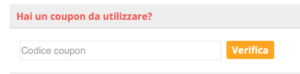
e cliccare su “Verifica”.
Successivamente, avviata la procedura di iscrizione, controlla se il codice coupon compare anche qui
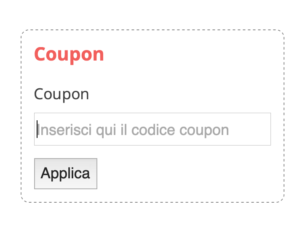
Altrimenti digitalo di nuovo e clicca su “Applica”, così il coupon sarà calcolato nel prezzo finale.
Modalità di accesso e utilizzo
Il corso online è fruibile sulla nostra piattaforma attraverso tutti i dispositivi: smartphone, tablet e pc collegati ad internet. L’accesso è sempre disponibile (24/24) e con durata illimitata.
Per accedere al corso, una volta acquistato (vedi modalità di iscrizione) basta cliccare sulla scritta in alto del sito “Accedi”.
Accedendo all’Area Utente con PC/Notebook o Tablet il pulsante “Accedi” è in alto a destra, come nell’immagine qui disponibile.

Se accediamo all’Area Utente da Smartphone, il pulsante “Accedi” è nella voce di menù a destra; occorre cliccare quindi l’icona del menù (cerchiata in rosso nell’immagine qui sotto) per visualizzarlo.

Si accede quindi al proprio account (usando le credenziali di registrazione) dove è disponibile l’accesso al corso online scelto, nella sezione “I MIEI CORSI” evidenziata nell’immagine qui sotto.